Mobile devices
make it easier for businesses to communicate with each other and their employees:
There
is, without a doubt, a strong tie between owning a mobile device, such as a
smart phone or tablet, and having an increased possible level of communication. An article on Forbes.com revealed that 69 percent of the time someone is
working on a tablet at work they are checking or using their email. At home, tablet users spend about 74 percent
of their time on email. According to an article on smallbusiness.chron.com, the ability of today’s mobile cell
phones to access the internet allows workers to stay in the field and receive
information instead of going back to the office.
In the following interview with
Dr. David Kirsch, Associate Professor of Management and Entrepreneurship at
University of Maryland, Kirsch says that he believes that managers and firms
can more effectively share information because teams in various countries/places
can communicate better with smart phones.
It is clear that mobile devices have a strong beneficial effect on
business communication around the world with information sharing, whether the
communication is countries or blocks away.
Mobile devices
increase productivity through communication among businesses:
Mobile
devices are increasing productivity among workplaces by increasing communication
and making communication easier. Many
firms and businesses are turning to mobile devices to increase productivity
including a hospital in Sarasota, Florida.
An article on bizjournals.com reveals that Sarasota Memorial Hospital has
given many of its staff iPhones with special adaptations and apps so that staff
can give each other information about patients’ conditions and medical needs. These iPhones have increased productivity
because staff can take less time trying to track down information about
patients because the answer is in their pocket on their phone.
Another article on Forbes.com tells the reader that farmers in India use smart
phones to share information in order to maximize on sales of their goods. This increases productivity because these
farmers spent the least amount of time finding a market with short sales lines
and high selling prices. Overall, mobile
devices have increased the possible level of productivity by sharing
information in order to save time and making a form of communication consistently
available.
 Mobile devices “blur”
the line between work and leisure for many business professionals:
Mobile devices “blur”
the line between work and leisure for many business professionals:
An article on mobiledevicemanager.com says that by the end of this year, half
of all U.S. sold mobile phones will be smartphones. This is an astounding fact that reflects
that half of all cell phone buyers in the U.S. will have access to the internet
at virtually all times. Being that most
companies communicate via email and phone call, that would mean that any of
these smartphone users could have work in their fingertips at any time.
What does this mean for the
workplace? Well, it means that getting
away from work will only become more difficult.
As much as having work at the touch of a button is a bonus for the
workplace and productivity’s sake, it is seen as a negative to many who enjoy
their leisure time. An employee could
get a phone call from a client, look up the clients’ information, and then send
an email to a business partner before hanging up with the client… and the
employee could have nothing on them but their smartphone. Mobile devices definitely make it more
difficult to escape and get away from work because they make it so easy to
access work related information.
Mobile devices are
becoming more prevalent and will continue to change how the business world
works through new apps and capabilities:
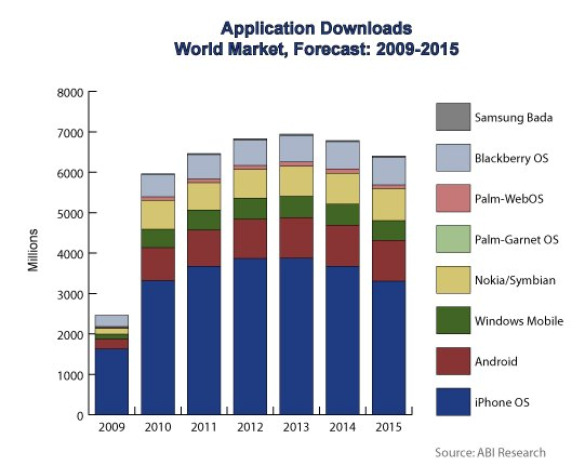 As previously stated, not only will half of the U.S. phones sold be smartphones by
the end of 2012 but additionally, according to a PWC survey, 66 percent of organizations are currently investing in mobile technologies. Larger sales of smartphones
will lead to more profits for smartphone companies which will in turn lead to new
operating systems, apps, and overall technologies. These organizations that are investing in
mobile technologies will also be creating new apps that will change the way
that the business world will communicate not only with each other but within each business.
As previously stated, not only will half of the U.S. phones sold be smartphones by
the end of 2012 but additionally, according to a PWC survey, 66 percent of organizations are currently investing in mobile technologies. Larger sales of smartphones
will lead to more profits for smartphone companies which will in turn lead to new
operating systems, apps, and overall technologies. These organizations that are investing in
mobile technologies will also be creating new apps that will change the way
that the business world will communicate not only with each other but within each business.
Many businesses that do not use
mobile technologies currently and are not willing to change will most likely
perish. The reason for this is because
organizations that neglect to develop a mobile platform will not be able to
challenge competing organizations on a productivity based level. Let’s be honest, a car goes faster than a
horse and buggy in the same way that a search engine is faster than flipping through an
encyclopedia. Below is a short audio
recording of an interview with a college student who explains that even him,
along with other workers at his workplace, use their smartphone for work-related
causes (specifically email).

Hello! Do you have personal pages in online social websites?
ReplyDelete